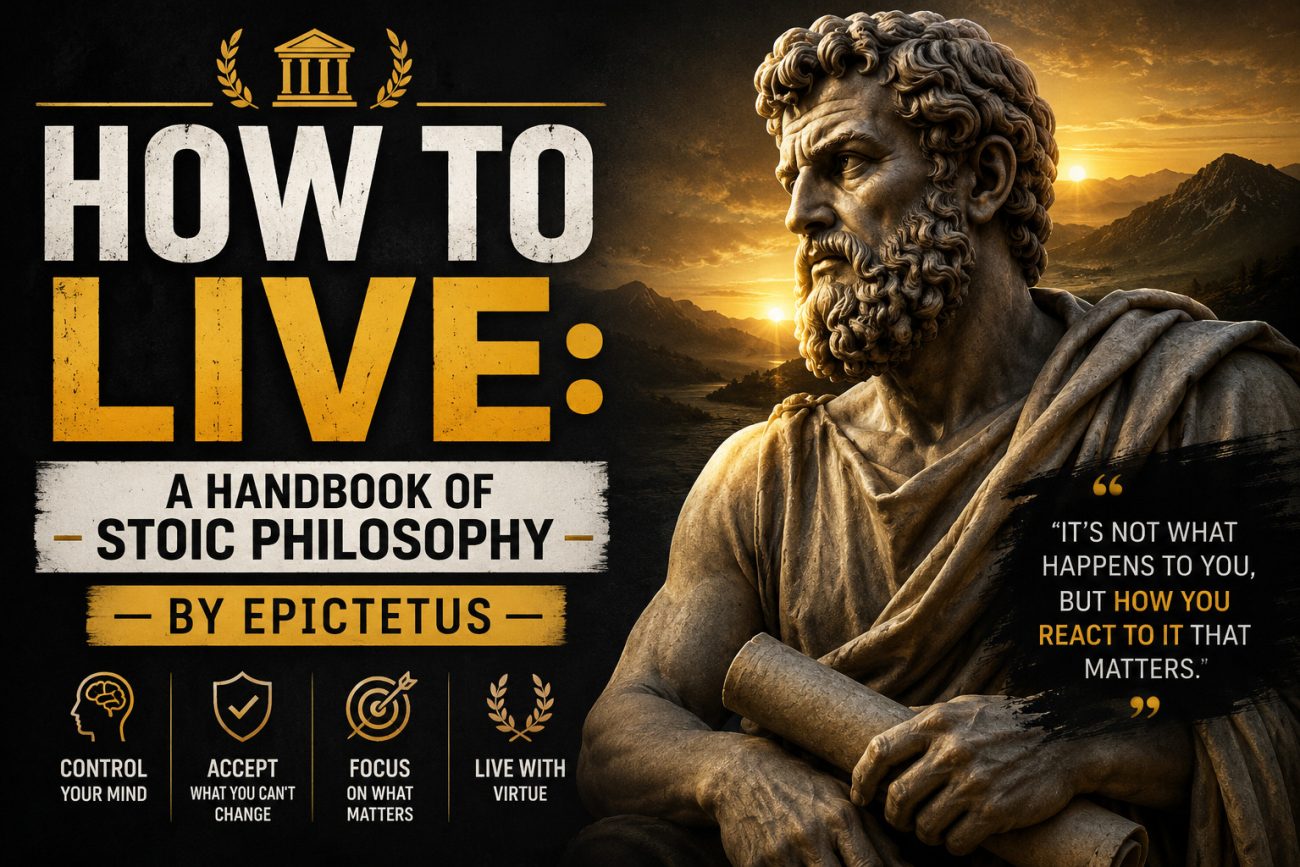
Who was Epictetus?
Epictetus was a Greek philosopher who lived about 2,000 years ago.
He was born around AD 50 and became one of the most important teachers of Stoicism.
One important point: Epictetus did not personally write the Discourses. They were recorded by his student Arrian. The Discourses contain four books, while the Enchiridion is a shorter practical handbook derived from his teachings.
📖 COMPLETE SIMPLE GUIDE TO EPICTETUS
First: What is this book actually trying to teach?
The entire book can be understood through one central question:
“What is in my control, and what is not?”
Epictetus says that a good life does not mean getting everything you want.
A good life means:
- controlling your own thoughts and actions
- accepting what you cannot control
- becoming mentally strong
- not being controlled by money, fame, people or circumstances
- doing your duties properly
- using reason instead of emotional reactions
- wanting reality to be the way it actually is
- becoming a good human being
In very simple words:
You cannot control everything that happens to you.
But you can control how you respond.
That is the foundation of the book.
PART 1 — THE MOST IMPORTANT STOIC IDEA
1. What is in your control?
Epictetus begins with the distinction between things that are up to us and things that are not up to us.
In your control
You can control:
- your judgments
- your decisions
- your desires
- your intentions
- your attitude
- your effort
- your actions
Not completely in your control
You cannot completely control:
- other people’s opinions
- your reputation
- your wealth
- your job outcome
- other people’s behavior
- your body
- illness
- accidents
- politics
- the weather
- whether someone likes you
- whether you succeed despite your best effort
- death
Example
Suppose you have an exam tomorrow.
You can control:
Studying → Yes
How seriously you study → Yes
Your effort → Yes
But:
What questions appear → No
How the examiner marks → No
Whether someone else performs better → No
So Epictetus says:
Focus your energy on the first group.
This is probably the single most important lesson in the entire book.
PART 2 — DON’T MAKE EXTERNAL THINGS YOUR HAPPINESS
Epictetus repeatedly says that external things are not automatically good or bad.
For example:
Money
Money itself isn’t moral goodness.
Having ₹10 lakh doesn’t make someone a good person.
Losing ₹10 lakh doesn’t automatically make someone a bad person.
The important question is:
How did you obtain it and how do you use it?
Fame
Being famous doesn’t make you good.
Being unknown doesn’t make you bad.
Beauty
Being attractive doesn’t make someone virtuous.
Position
Being a CEO, politician, professor or labourer doesn’t determine your character.
Your character matters more than your social position.
PART 3 — YOUR JUDGMENTS CREATE MUCH OF YOUR SUFFERING
This is another major idea.
Epictetus teaches that events themselves don’t automatically create our emotional suffering.
Our judgment about the event plays a major role.
Example
Someone doesn’t reply to your message.
Event:
They didn’t reply.
Your mind may say:
“They don’t respect me.”
Then:
“Maybe they hate me.”
Then:
“Everyone ignores me.”
Now you’re angry or sad.
But none of those conclusions were necessarily facts.
The Stoic approach is:
Fact:
“They haven’t replied.”
Stop there.
Don’t immediately add a story.
PART 4 — LEARN TO QUESTION YOUR FIRST REACTION
Your mind constantly produces impressions.
Something happens.
Your brain immediately says:
“This is terrible.”
Epictetus says:
Wait.
Ask:
- What actually happened?
- What am I assuming?
- Is my judgment accurate?
- Is this within my control?
- What is the appropriate action?
This creates a gap between:
Event → Reaction
Instead of:
Event → Emotional explosion
you develop:
Event → Pause → Judgment → Action
That is Stoic discipline.
PART 5 — DON’T DEMAND THAT LIFE FOLLOW YOUR PLAN
One of Epictetus’s most powerful teachings is:
Don’t constantly say:
“I want life to happen exactly the way I want.”
Instead learn to say:
“I will deal with life as it actually happens.”
Example
You planned to go outside.
It rains.
You can think:
“This is horrible! My whole day is ruined!”
Or:
“It is raining. I can’t control the weather. What can I do now?”
The second response is Stoic.
PART 6 — ACCEPTANCE DOES NOT MEAN LAZINESS
This is very important.
Stoicism does not mean:
“Do nothing.”
It means:
Do everything you can about what you control and accept the result you cannot control.
Example:
You apply for a job.
Your responsibility:
- prepare your CV
- improve your skills
- prepare for interview
- attend interview
- communicate properly
After that:
Whether they select you is not completely yours.
So you should care about your effort and character, not become mentally destroyed by the outcome.
PART 7 — DESIRE
Epictetus believes that uncontrolled desire creates suffering.
Suppose you think:
“I must become rich.”
Then your happiness depends on becoming rich.
If you don’t become rich:
suffering.
Instead:
“I will work hard to improve my financial situation, but my happiness will not depend entirely on becoming rich.”
That’s much more stable.
PART 8 — DON’T BECOME A SLAVE TO PLEASURE
If you constantly need:
- entertainment
- social media
- compliments
- food
- sex
- shopping
- luxury
- attention
then those things start controlling you.
Epictetus’s idea of freedom is interesting:
A person can physically be free but mentally be a slave.
For example:
Someone might say:
“I cannot stop checking Instagram.”
Then Instagram controls him.
Another person might say:
“I need everyone to like me.”
Then other people’s opinions control her.
Another:
“I cannot live without luxury.”
Then luxury controls him.
Stoicism asks:
Who is controlling your mind?
PART 9 — FREEDOM
For Epictetus, real freedom isn’t simply:
“Nobody can physically stop me.”
Real freedom is:
“My mind is not controlled by external things.”
If someone insults you and you immediately lose control:
They have gained power over your mind.
If someone praises you and you become dependent on their praise:
They also have power over your mind.
The Stoic wants inner independence.
PART 10 — DON’T DEPEND ON OTHER PEOPLE’S OPINIONS
Imagine someone says:
“You’re stupid.”
You don’t automatically have to believe it.
Ask:
Is it true?
If yes:
Improve.
If no:
Ignore it.
The mistake is allowing every opinion to determine your self-worth.
PART 11 — INSULTS
Suppose someone insults you.
The Stoic response isn’t necessarily:
“I must insult them back.”
Instead:
Why should their behavior control mine?
Their behavior belongs to them.
Your response belongs to you.
PART 12 — ANGER
Epictetus talks repeatedly about anger.
When another person does something wrong, we often think:
“How could they do this to me?”
Epictetus says we should remember that people often act according to what they believe is right.
That doesn’t mean their actions are actually right.
It means:
Understand the cause before reacting emotionally.
And if correction is necessary, correct the person without becoming consumed by rage.
PART 13 — OTHER PEOPLE WILL MAKE MISTAKES
People will:
- lie
- cheat
- misunderstand you
- criticize you
- disappoint you
- behave selfishly
- make stupid decisions
You cannot prevent all of this.
So your goal shouldn’t be:
“I must make everyone behave correctly.”
Your goal should be:
“I will behave correctly even when others don’t.”
That’s a very important Stoic principle.
PART 14 — DON’T TRY TO CONTROL PEOPLE
You cannot control:
- your girlfriend/boyfriend
- your friends
- your parents
- your boss
- your employees
- strangers
- social media users
You can influence people, but you don’t control their minds.
Therefore:
Give advice when appropriate.
Do your duty.
Then accept their decision.
PART 15 — RELATIONSHIPS
Epictetus doesn’t tell you to stop loving people.
Instead, he teaches you not to make another person’s existence the foundation of your entire psychological stability.
Love people.
Care about them.
Help them.
But remember:
They are mortal.
People can leave.
People can die.
Relationships can change.
Understanding this isn’t meant to make you cold.
It is meant to make you appreciate people while you have them.
PART 16 — DEATH
Death is a major theme in Stoicism.
Epictetus says death is something we cannot ultimately control.
Therefore, constantly fearing it doesn’t solve anything.
Instead ask:
“Since death is inevitable, how should I live today?”
This changes the question from:
“How can I avoid death?”
to:
“How can I live well?”
PART 17 — YOUR BODY
Your body matters, but Stoicism doesn’t treat physical appearance as the highest good.
You can:
- exercise
- eat properly
- sleep
- take care of yourself
But don’t make your entire identity dependent on appearance.
For example:
“If I don’t look attractive, I’m worthless.”
That’s the wrong conclusion.
Your body is something you should care for.
Your character is something you should develop.
PART 18 — WEALTH
Epictetus isn’t simply saying:
“Money is bad.”
His point is:
Money should be a tool, not your master.
You can want money.
You can work for money.
You can save money.
But don’t make:
money = self-worth
or
money = happiness
PART 19 — SUCCESS AND FAILURE
This is one of the most useful lessons for modern life.
Most people define success as:
“I got the result I wanted.”
Epictetus asks you to look at something else:
Did I perform my role properly?
Suppose two people start businesses.
Person A works honestly, studies the market, treats customers properly and works hard but fails.
Person B cheats customers and becomes rich.
According to Stoicism:
Person B’s wealth doesn’t automatically make him morally successful.
Person A’s financial failure doesn’t automatically make him morally worthless.
Why?
Because external results aren’t the ultimate measure of character.
PART 20 — THE “ACTOR IN A PLAY” IDEA
Epictetus uses the idea that life is like a play.
You don’t choose every role.
You might be:
- rich or poor
- healthy or sick
- powerful or powerless
- famous or unknown
Your responsibility is:
Play your role well.
If you are a student:
Be a good student.
If you are a parent:
Be a good parent.
If you’re an employee:
Be a good employee.
If you’re a friend:
Be a good friend.
You don’t need to envy someone else’s role.
PART 21 — DUTY
Stoicism isn’t only about feeling calm.
It’s about doing your duty.
Ask:
“What is my responsibility in this situation?”
Then do it.
For example:
Student
Study.
Employee
Do your work properly.
Friend
Be trustworthy.
Family member
Help where reasonably possible.
Citizen
Act responsibly.
PART 22 — VIRTUE
For Epictetus, the highest goal is not:
Money
or
fame
or
comfort
but virtue.
The major Stoic virtues include:
1. Wisdom
Knowing what is actually good, bad and within your control.
2. Courage
Doing the right thing even when you’re afraid.
3. Justice
Treating people fairly.
4. Self-control
Not being controlled by impulses.
In simple words:
Become a better person, not merely a more successful person.
PART 23 — PHILOSOPHY IS NOT JUST READING BOOKS
This is one of Epictetus’s strongest criticisms.
You can read:
- Plato
- Aristotle
- Epictetus
- Marcus Aurelius
- Seneca
and still be a terrible person.
Why?
Because knowing philosophy isn’t enough.
You must practice it.
For example:
Reading:
“Don’t become angry.”
is knowledge.
Someone insults you and you remain calm:
That’s practice.
PART 24 — DON’T SHOW OFF YOUR PHILOSOPHY
Epictetus criticizes people who use philosophy to look intelligent.
For example:
“I know Stoicism. I know Marcus Aurelius. I know Epictetus.”
But then they lose their temper over something tiny.
Epictetus would basically say:
Don’t tell people you’re philosophical. Show them through your behavior.
PART 25 — PROGRESS TAKES TIME
Epictetus compares improvement to fruit growing.
A grape doesn’t appear instantly.
It must:
flower → develop → mature → ripen
Human character works similarly.
You won’t become mentally strong in three days.
You practice:
Day 1 → Day 2 → Day 3 → months → years
Slow improvement is still improvement.
PART 26 — TRAIN YOUR MIND
Just as you train your body, you need to train your mind.
When something difficult happens, don’t immediately ask:
“Why is this happening to me?”
Ask:
“How can I practice my philosophy here?”
Someone insults you?
Practice patience.
You lose money?
Practice acceptance.
Someone rejects you?
Practice emotional independence.
You fail?
Practice learning.
Someone criticizes you?
Practice examining whether the criticism is true.
Your difficulties become training opportunities.
PART 27 — DIFFICULTY CAN MAKE YOU STRONGER
Epictetus doesn’t say:
“Seek suffering for no reason.”
Instead:
When difficulties inevitably appear, use them to develop character.
Think about gym training.
A muscle becomes stronger through resistance.
Epictetus applies a similar idea to character:
Difficulty → practice → stronger character
PART 28 — FEAR
Fear often comes from imagining future events.
Example:
“What if I fail?”
“What if everyone laughs at me?”
“What if I lose my job?”
“What if she leaves me?”
Epictetus encourages you to return to the present:
What is actually happening right now?
Then:
What can I do about it?
PART 29 — ANXIETY
A Stoic approach to anxiety is:
Step 1
Identify the event.
Step 2
Separate facts from assumptions.
Step 3
Identify what you control.
Step 4
Take the appropriate action.
Step 5
Accept the remaining uncertainty.
This prevents endless mental speculation.
PART 30 — DON’T TRY TO PREDICT EVERYTHING
Humans want certainty.
But life contains uncertainty.
You don’t know:
- tomorrow’s events
- people’s future decisions
- future economic conditions
- future health
- future relationships
So instead of demanding certainty:
Develop the ability to handle uncertainty.
That’s a much stronger form of mental resilience.
PART 31 — ATTENTION
Epictetus repeatedly emphasizes attention.
You need to watch your own mind.
For example:
You notice:
“I’m becoming jealous.”
Instead of immediately acting on jealousy:
Notice it.
Then ask:
“Why am I feeling this?”
This is philosophical self-awareness.
PART 32 — IMPRESSIONS
A Stoic concept you will encounter repeatedly is impressions.
An impression is basically:
Your mind’s first appearance/interpretation of something.
Example:
Someone laughs while looking at you.
Your first thought:
“They’re laughing at me.”
That’s an impression.
Don’t immediately treat it as fact.
Ask:
Do I actually know that?
Maybe they were laughing at something else.
PART 33 — ASSENT
After an impression appears, your mind can either:
accept it
or
question it.
This is extremely important.
Example:
Impression:
“Everyone hates me.”
Stoic response:
“Wait. Is that actually true?”
This gives you control over your thinking.
PART 34 — LOGIC
Epictetus also discusses logic and reasoning.
Why?
Because if your thinking is bad, your decisions will also be bad.
You need to learn to distinguish:
fact
from
assumption
and:
what happened
from
what you think happened.
PART 35 — DON’T SEEK CONSTANT PRAISE
Suppose you post a photo online.
You get 500 likes.
You feel great.
Next day:
50 likes.
You feel terrible.
Now your emotional state depends on strangers.
Epictetus would ask:
Why have you given strangers control over your happiness?
Do your work well.
Accept praise when it comes.
But don’t become dependent on it.
PART 36 — DON’T LIVE FOR APPEARANCES
People often care about:
“What will people think?”
Stoicism asks:
“What is actually right?”
Those aren’t always the same thing.
You should prioritize:
character > reputation
PART 37 — JEALOUSY
You see someone with:
- better body
- better car
- more money
- better relationship
- better job
- more followers
Your mind says:
“Why don’t I have that?”
Stoicism says:
Instead of wasting energy comparing:
Work on what belongs to you.
Their life is their life.
Your task is to improve your own character and actions.
PART 38 — COMPARISON
Comparison often creates unnecessary suffering.
If someone is ahead of you:
Learn from them.
If someone is behind you:
Don’t become arrogant.
Your competition is primarily:
the person you were yesterday.
PART 39 — SOCIAL STATUS
Don’t become obsessed with impressing powerful people.
Epictetus discusses people who desperately seek advancement and approval.
The Stoic question is:
“Am I becoming a better human being?”
not:
“Am I becoming important in other people’s eyes?”
PART 40 — FRIENDSHIP
Good friendship should involve:
- honesty
- loyalty
- respect
- mutual goodwill
But don’t make friendship simply a transaction:
“I’ll be your friend because you benefit me.”
That’s shallow.
PART 41 — PHILOSOPHY AND DAILY LIFE
The real test of philosophy is ordinary life.
Imagine:
You’re late.
Someone cuts in front of you.
Your internet stops working.
Your boss criticizes you.
Someone insults you.
Your plans fail.
Your friend disappoints you.
These are philosophical exercises.
Ask:
“Can I respond properly?”
PART 42 — WHAT EPICTETUS MEANS BY “GOOD”
This is subtle.
He doesn’t consider every desirable external thing to be truly good.
For example:
Money can be useful.
But money doesn’t make you morally good.
Likewise:
Poverty doesn’t automatically make you morally bad.
The deeper good is:
how you use your reason and character.
PART 43 — WHAT EPICTETUS MEANS BY “BAD”
The real bad is connected to bad character and wrong use of judgment.
For example:
- dishonesty
- injustice
- cowardice
- uncontrolled desire
- irrational judgment
These are more important than losing possessions.
PART 44 — INDIFFERENTS
Stoicism sometimes calls external things “indifferent.”
This does not mean:
“Nothing matters.”
It means external things aren’t what determines your moral worth.
Health is normally preferable to sickness.
Money can be preferable to poverty.
But neither determines whether you are a good person.
PART 45 — PREFERRED THINGS
You can reasonably prefer:
health over illness
wealth over poverty
freedom over imprisonment
But if you don’t get your preference, you shouldn’t destroy your inner peace.
So:
Prefer things, but don’t become their slave.
PART 46 — GOD, NATURE AND PROVIDENCE
Epictetus’s Stoicism is religious/philosophical in a way that may feel different from modern self-help.
He often speaks about:
- God
- divine reason
- Providence
- nature
- the rational order of the universe
His basic idea is that the universe has an order and human beings should live according to reason and nature.
If you’re reading this from a modern secular perspective, you can still understand the practical principle:
You are part of something larger than your personal desires.
PART 47 — ACCEPT THE ORDER OF LIFE
You may dislike reality.
But disliking reality doesn’t change it.
Someone has died.
The past cannot be changed.
A decision has already happened.
The weather changed.
Someone rejected you.
The Stoic asks:
“What is the wise response now?”
Not:
“How can I make the past different?”
PART 48 — DON’T FIGHT REALITY
There are two types of pain:
Necessary pain
Something difficult actually happens.
Added mental pain
Your mind keeps saying:
“This shouldn’t have happened!”
“It’s unfair!”
“Why me?”
“I can’t accept this!”
Sometimes the event is painful enough.
Then we add another layer through resistance.
Stoicism tries to remove the unnecessary layer.
PART 49 — THE STOIC RESPONSE TO LOSS
If you lose something valuable:
Don’t pretend you don’t care.
Instead remember:
“I knew this was temporary.”
Everything external is temporary.
Your possessions.
Your position.
Your youth.
Your relationships.
Your body.
Eventually life itself.
This awareness encourages appreciation without excessive attachment.
PART 50 — GRATITUDE
Stoicism can therefore produce gratitude.
If you understand something is temporary, you appreciate it more.
Instead of:
“I deserve this.”
Think:
“I’m fortunate to have this today.”
PART 51 — PRACTICAL DAILY STOICISM
Here’s how you can apply the book every day.
Morning
Ask:
What can I control today?
What responsibilities do I have?
What difficulties might I face?
During the day
When something goes wrong:
Pause.
Ask:
“Is this in my control?”
If yes:
Act.
If no:
Accept.
Night
Ask:
- Where did I lose control?
- Where did I react unnecessarily?
- Did I act according to my values?
- What can I improve tomorrow?
This turns philosophy into practice.
THE ENCHIRIDION — THE SHORT PRACTICAL HANDBOOK
The Enchiridion is basically Epictetus’s compact practical manual. It contains 53 short sections in the traditional text.
Think of it as:
Discourses = classroom
Enchiridion = pocket handbook
The Enchiridion repeatedly returns to ideas such as:
Section 1
Control vs things outside your control.
Sections 2–3
Be careful about what you desire and become attached to.
Section 4
Prepare mentally before entering difficult situations.
Section 5
Events don’t automatically determine your emotional response; your judgments matter.
Section 8
Don’t demand that reality obey your wishes. Align your wishes with reality.
Section 10
When something happens, ask what it can teach you.
Section 11
Remember that external things are temporary.
Section 14
Don’t demand that other people behave exactly as you want.
Section 15
Handle situations according to their importance rather than emotional impulse.
Section 17
Think of yourself as an actor performing an assigned role.
Sections 18–19
Don’t become obsessed with signs, predictions, status or other people’s opinions.
Sections 20–21
Don’t allow insults or external events to control your mind.
Section 22 onward
Continue training yourself rather than merely talking about philosophy.
Later sections
Discuss:
- relationships
- reputation
- wealth
- social status
- criticism
- death
- philosophy
- self-control
- responsibility
- freedom
- rational thinking
The full traditional contents of the larger Discourses similarly cover control, progress, providence, anger, courage, tranquillity, friendship, anxiety, logic, freedom, attention and many everyday situations. (Vreeman.com)
📚 THE FOUR BOOKS OF THE DISCOURSES
The larger Discourses are divided into four surviving books. (Vreeman.com)
BOOK 1 — BUILDING THE FOUNDATION
Major subjects include:
- what is in our power
- human nature
- God and Providence
- progress
- reason
- anger
- dealing with difficult circumstances
- freedom
- courage
- responsibility
- philosophy
Main message:
Understand yourself and distinguish your control from what isn’t yours.
BOOK 2 — TRAINING THE MIND
Major themes include:
- courage
- tranquillity
- anxiety
- indifference
- desire
- philosophy
- correcting impressions
- friendship
- logical reasoning
- inconsistency
- philosophical practice
Main message:
Don’t just understand Stoicism. Train yourself to live it.
BOOK 3 — BECOMING A PRACTICING PHILOSOPHER
Themes include:
- discipline
- practice
- appearance
- self-control
- Cynicism
- reading philosophy properly
- avoiding show-off philosophy
- desire
- fear of poverty
- using external circumstances
Main message:
Philosophy must change your behavior.
BOOK 4 — FREEDOM
Major themes include:
- freedom
- fear
- social relationships
- tranquility
- attachment
- reputation
- purity
- attention
- dealing with other people
Main message:
Real freedom comes from mastering yourself, not controlling the world.
🧠 THE ENTIRE BOOK IN 20 RULES
If you remember nothing else, remember these:
Rule 1
Control what you can.
Rule 2
Accept what you cannot control.
Rule 3
Don’t confuse your opinions with facts.
Rule 4
Pause before reacting.
Rule 5
Don’t let other people’s behavior control your emotions.
Rule 6
Don’t make money your master.
Rule 7
Don’t make fame your master.
Rule 8
Don’t make people’s approval your master.
Rule 9
Don’t demand that reality follow your wishes.
Rule 10
Wish to deal wisely with whatever happens.
Rule 11
Focus on your actions rather than outcomes.
Rule 12
Do your responsibilities properly.
Rule 13
Build character rather than appearance.
Rule 14
Use difficulties as training.
Rule 15
Don’t run away from every uncomfortable situation.
Rule 16
Question your first emotional impression.
Rule 17
Remember that external things are temporary.
Rule 18
Don’t waste energy trying to control other people.
Rule 19
Practice philosophy instead of merely talking about it.
Rule 20
Your greatest freedom is control over your own mind and choices.
⭐ THE MOST IMPORTANT IDEA TO TAKE FROM THIS BOOK
If I had to reduce the entire Enchiridion + Discourses to one sentence:
“Take responsibility for what belongs to you—your judgments, choices, desires and actions—and calmly accept what does not.”
That is why this book is still useful today. The modern descriptions of the work similarly emphasize inner strength, resilience, rational response to challenges, virtue and practical Stoic living.
One important distinction
Stoicism does NOT mean:
❌ Never feel emotions
❌ Become emotionless
❌ Don’t care about anyone
❌ Don’t work for money
❌ Don’t enjoy life
❌ Accept abuse
❌ Never fight for anything
❌ Become passive
It means:
Feel → understand → think → choose → act wisely.
